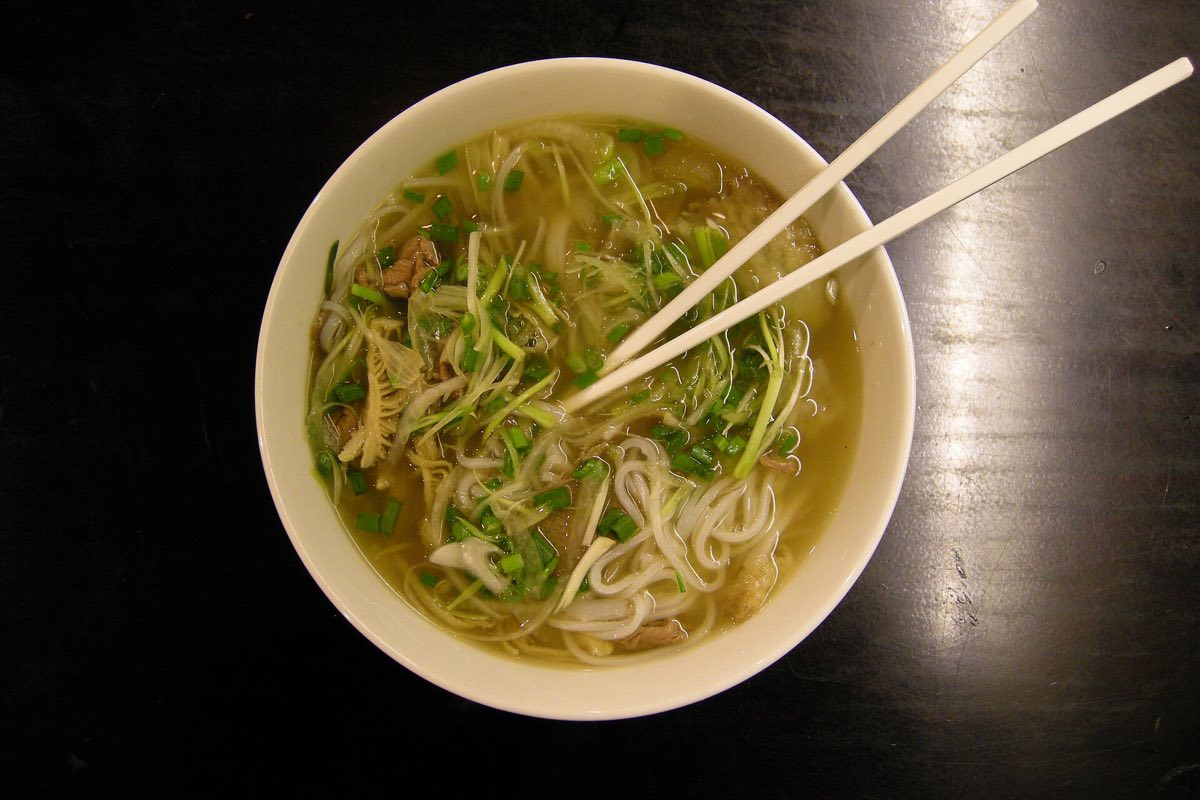
Chaolong: Puerto Princesa's Vietnamese noodle soup
Eat it at least twice. Chaolong is a beef-stew noodle soup that Vietnamese refugees brought to Palawan after the fall of Saigon, adapted by Palaweños with calamansi, mung bean sprouts and — the part nobody expects — banana ketchup sweetening the broth. A bowl with a garlic-cheese baguette runs ₱60–120 (~$1–2), up to ₱230 at the tourist end. Bona's Chao Long Haus on Manalo Street does the beef stew version at ₱85 with Vietnamese coffee at ₱50 and holds a 4.6 aggregate. The name is almost certainly wrong, which is part of the story.
A beef noodle soup with a Filipino sweet tooth
Order chaolong expecting phở and you will be surprised twice: once by the bread, and once by the sugar. Both are the point.
The bowl that arrives is rice noodles in a dark, faintly reddish beef broth with slow-cooked beef or pork buto-buto — bone cuts — topped with mung bean sprouts and served with wedges of calamansi. Alongside it comes a French baguette made with a wheat-and-rice flour blend, which you either tear and dunk or order filled. Garlic-cheese is the classic order and it is exactly as heavy-handed as that sounds.
The broth is sweet, and this is where every first-timer review goes wrong. Reviewers at Bona's regularly complain that the soup runs sweet and the pork can be chewy. The sweetness is not a mistake — it comes from banana ketchup, itself a Filipino wartime invention created when tomatoes ran short and bananas did not, and it is authentic to the Palawan style rather than a corruption of it. If you want the unsweetened original you want phở, and you will not find it here outside Viet Ville.
The price is the other headline. ₱60–120 (~$1–2) a bowl across a dozen-plus houses on Rizal Avenue and Manalo Street, rising to about ₱230 at the tourist-facing end. It is the city's default cheap lunch, its hangover breakfast and its homecoming meal — and by local count there are at least seven chaolong houses within a minute's ride of the airport, which tells you everything about how locals treat a landing.
How a Vietnamese soup ended up in Palawan
The boats arrive
Saigon falls, and Vietnamese boat people cross the South China Sea. Palawan is the closest Philippine landfall on that route, and Puerto Princesa becomes a reception point almost by geography alone.
The Philippine First Asylum Center opens
A joint effort of the Philippine government, UNHCR and the Catholic Church, the centre houses arrivals in the city while they wait for resettlement decisions. Refugees cook and sell what they know: noodle soup and baguettes.
Viet Ville is built at Km 13
A longer-term settlement goes up at Brgy. Sta. Lourdes: 13 hectares, about 200 homes, a Buddhist pagoda and a Catholic chapel, plus noodle and bread workshops, housing roughly 2,000 people. The village is still there, and mostly empty.
The name sticks
Palaweños eat in and around the camp, ask what the dish is called, and a word gets attached to a soup it does not describe. Local versions pick up calamansi in place of lime and banana ketchup in the broth.
The funding ends
The programme winds down. Most residents resettle to the United States, Canada and Australia; some marry Palaweños and stay. What remains in the city is a network of family-run noodle houses and one emptying village.
The dish outlived the camp
There are more chaolong houses in Puerto Princesa now than there were Vietnamese families at the peak of the settlement. A bowl costs ₱85. That is the whole story, and almost no guide to this city tells it.
It is almost certainly the wrong word
In Vietnam, cháo lòng is a rice porridge made with pork offal. The Palawan dish is a beef-stew noodle soup. They are not the same dish and nobody is pretending otherwise.
What Puerto Princesa serves is much closer to phở bò kho — the beef-stew branch of the phở family — than to anything called cháo lòng in Vietnam. The most-repeated local explanation is a straightforward mishearing: outsiders ate in the camp, asked what the dish was, took away a word that was being used for something else on the same table, and the name stuck to the wrong bowl for forty years.
That is a legend, not a documented event, and this site is not going to pretend it is settled history. What is documented is the mismatch itself, and it is worth knowing before you order — because if you go looking for cháo lòng in Hanoi on the strength of a good lunch in Palawan, you will be handed offal porridge.
Palawan chaolong against Vietnamese phở
Four differences, and the fourth is the one that decides whether you like it. None of them is an error.
| Element | Vietnamese phở | Palawan chaolong |
|---|---|---|
| The sour note | Lime | Calamansi — smaller, more floral, more perfumed |
| The herbs | Mint, Thai basil, culantro, a whole plate of them | Mung bean sprouts, and often little else |
| The broth | Clear, long-simmered, savoury and aromatic | Darker, stewed, and sweetened with banana ketchup — a Filipino WWII invention |
| The bread | None, in the north at least | A wheat-and-rice-flour French baguette you tear and dunk, or have filled with garlic and cheese |
| The price | Whatever a bowl costs at home | ₱60–120, about $1–2 |
If the sweetness bothers you, ask for extra calamansi and chilli before you write the bowl off. Most complaints about sweet chaolong are complaints about an unbalanced bowl, not a bad one.
The chaolong houses, ranked
Four named houses plus the village restaurant. Bona's for the food, Rene's for the convenience, Viet Ville for the pilgrimage — that is the whole decision.
| House | Where | Price | Hours | Verdict |
|---|---|---|---|---|
| Bona's Chao Long Haus 4.6 aggregate · beef stew chaolong ₱85 · Vietnamese coffee ₱50 | Manalo Street, about 3 km from the centre | ₱85–150 | To about 21:00 | WORTH IT |
| Rene's Saigon The most tourist-known name in the genre; on TripAdvisor's 2025 best-Vietnamese list | Rizal Avenue | ₱60–150 | UNVERIFIED — call ahead | WORTH IT |
| Noki Nocs Savory House Also the town's named halo-halo address, at ₱80–150 | Corner of North Road and Rizal Ave | ₱60–150 | About 10:00–20:30 | WORTH IT |
| Nitchie's Chaolong A local name that circulates in the genre; details thin | City centre | ₱60–120 | UNVERIFIED | DEPENDS |
| Viet Ville restaurant Chaolong ₱170, pho ₱230 — you are paying for the setting and the story | Km 13, Brgy. Sta. Lourdes, north of the city | ₱100–250 | Listed 08:00–20:00, UNVERIFIED | DEPENDS |
Chaolong houses do not take reservations and most do not take cards. Bring cash, walk in, point at what the next table has.
Bona's Chao Long Haus, in practice
Rene's Saigon, in practice
Current reviews and hours
Nobody sells a chaolong tour and nobody takes a chaolong booking. What is worth two minutes is confirming the place is open, because hours in this genre are informal and several listings are stale.
Chaolong questions, answered
What is chaolong?
A beef-stew noodle soup brought to Palawan by Vietnamese refugees after 1975 and adapted locally with calamansi, mung bean sprouts and banana ketchup in the broth. It costs ₱60–120 a bowl and comes with a French baguette you tear and dunk. It is the closest thing Puerto Princesa has to a signature dish.
Why is it called chaolong if it is not chaolong?
Because the name is almost certainly a mishearing. In Vietnam, cháo lòng is a pork-offal rice porridge; the Palawan dish is much closer to phở bò kho, a beef-stew noodle soup. Local legend says outsiders ate in the camp that opened here in 1979, asked what the dish was, and the wrong word stuck for the 40-odd years since.
Where is the best chaolong in Puerto Princesa?
Bona's Chao Long Haus on Manalo Street, about 3 km from the centre, at ₱85 a bowl with a 4.6 aggregate and reviews through March 2026. Rene's Saigon on Rizal Avenue is the more famous name and more convenient if you are staying downtown, at ₱60–150.
Why is the chaolong broth sweet?
Banana ketchup, which sweetens and reddens it. That is a Filipino invention from the Second World War, when tomatoes were scarce and bananas were not, and it is authentic to the Palawan style rather than a mistake. It is the most common complaint in reviews of the ₱85 bowl at Bona's — add calamansi and chilli before you give up on it.
How much does chaolong cost?
₱60–120 (~$1–2) a bowl at most of the dozen-plus houses in the city, ₱85 at Bona's, and up to ₱230 at the tourist end including ₱170 at the Viet Ville restaurant. Add ₱50 for a Vietnamese coffee and you have eaten well for under ₱150.
Is chaolong vegetarian?
No. The broth is beef, at every house, and adding egg or vegetable noodles does not change that. Vegetarians should go to Ima's Gulay Bar on Fernandez Street instead, where mains run ₱150–350 and vegan options are flagged.
Where did the Vietnamese in Palawan come from?
They were boat people who fled after the fall of Saigon in 1975. The Philippine First Asylum Center opened in Puerto Princesa in 1979 and a purpose-built settlement, Viet Ville, went up at Km 13 in 1985 — 13 hectares, about 200 homes and roughly 2,000 residents. Most resettled abroad in the early 2000s.
Can you still visit the Vietnamese village?
Yes, and it is about 13 km north of the city on the way to Honda Bay. The village is semi-abandoned with the pagoda still standing, and its only operating business is the Viet Ville restaurant, where pho is ₱230. Listed hours are 08:00–20:00 but they are unverified — check before making the trip.